
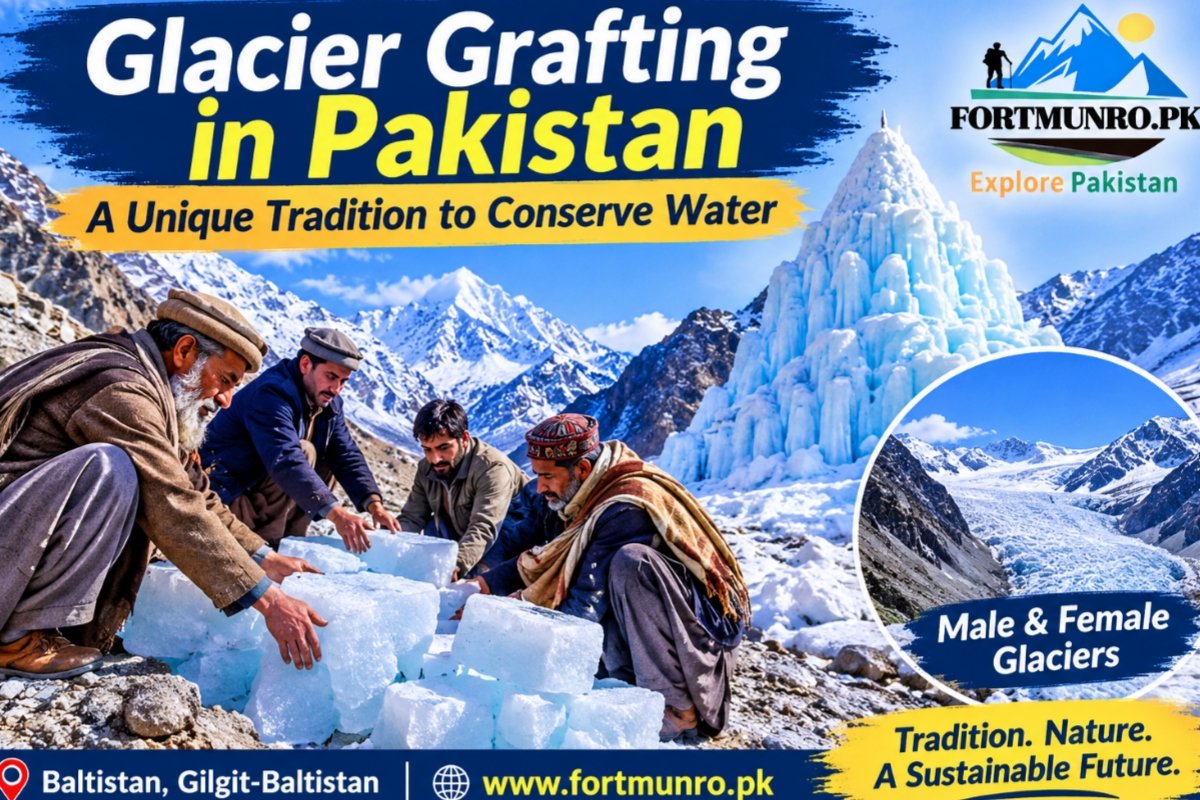
Glacier Grafting in Pakistan: A Unique Tradition
Discover Glacier Grafting in Pakistan, a unique Balti tradition of joining ice to preserve water for farming and support mountain communities.
Introduction
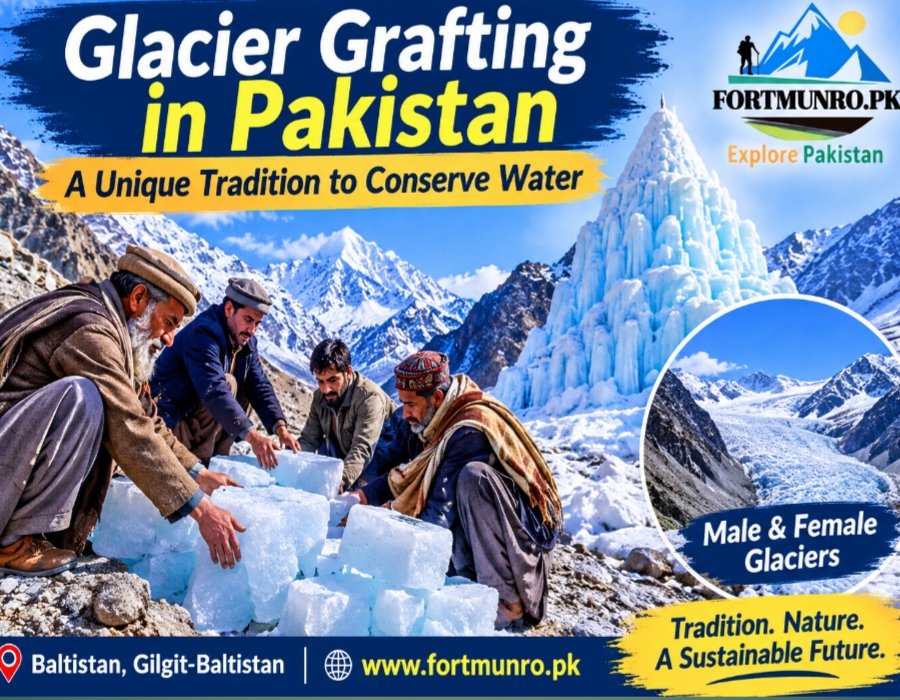
In the beautiful mountains of northern Pakistan, an extraordinary tradition has been practiced for generations. Known as Glacier Grafting in Pakistan, this fascinating local technique involves bringing together pieces of ice from different glaciers to create or strengthen an ice reserve. Locally known as Gang Khswa in the Balti language, this practice reflects the deep relationship between mountain communities and their natural environment.
Unlike modern water storage systems, Glacier Grafting in Pakistan is based on traditional knowledge, collective efforts, and an understanding of the surrounding mountains. Local communities believe that combining different types of glacier ice can help preserve frozen water for longer periods. This water may later support agriculture, orchards, livestock, and everyday life in remote mountain villages.
The tradition is particularly interesting because it combines cultural beliefs with environmental adaptation. In a region where communities depend heavily on snow and glacier meltwater, every drop of water matters. Glacier Grafting in Pakistan is therefore more than an unusual mountain tradition; it represents an indigenous approach to water conservation and the challenges of changing climatic conditions.
Quick Answer: What Is Glacier Grafting in Pakistan?
Glacier Grafting in Pakistan is a traditional water conservation practice found in parts of Gilgit-Baltistan, particularly Baltistan. Known as Gang Khswa, it involves collecting ice from different glaciers and placing it at a carefully selected high-altitude location. Local communities hope that the combined ice will develop into a larger frozen reserve and provide water for agriculture during warmer months.
Location: Where Is Glacier Grafting Practiced?
Glacier grafting is traditionally associated with Baltistan in Gilgit-Baltistan, northern Pakistan. Communities in areas such as Skardu, Shigar, Ghanche, and Kharmang have been associated with this indigenous practice.
These mountain settlements are surrounded by high peaks, glaciers, and snow-covered landscapes. Their agricultural activities depend considerably on seasonal water supplies from the surrounding mountains.
1. Why Do Local Communities Arrange Glacier Marriages?
The Importance of Water for Mountain Villages
Northern Pakistan is home to communities whose livelihoods are closely connected to mountain water resources. Farmers depend on glacier meltwater to irrigate wheat fields, vegetable gardens, orchards, and other agricultural land. During warmer months, water availability becomes particularly important for maintaining crops and supporting livestock.
In some remote villages, water shortages can affect agricultural production and daily activities. This is one reason why local communities have developed traditional methods of preserving ice. Glacier Grafting in Pakistan represents one such effort, through which people attempt to increase the availability of frozen water for future seasons.
A Traditional Response to Water Shortages
The practice is based on the understanding that suitable high-altitude locations can preserve ice for extended periods. Local people carefully select shaded mountain areas where temperatures remain low and direct sunlight is limited.
Although modern scientific research has not established glacier grafting as a guaranteed solution to water scarcity, it remains an important example of indigenous environmental knowledge. Its value also lies in community participation and the preservation of cultural traditions.
2. What Are Male and Female Glaciers?
The Traditional Balti Understanding
One of the most fascinating aspects of Glacier Grafting in Pakistan is the local belief that glaciers have different genders. In traditional Balti culture, glaciers covered with rocks and soil are commonly described as male glaciers, while cleaner white or bluish glaciers are considered female glaciers.
According to local beliefs, female glaciers are associated with greater water production and growth, whereas male glaciers are believed to move more slowly and release less water. People traditionally bring ice from both types and combine them at a selected location.
Scientific Explanation of Glacier Types
It is important to understand that male and female glaciers are cultural descriptions rather than scientific classifications. Glaciologists do not officially divide glaciers into male and female categories.
The differences in glacier appearance are generally related to debris cover, ice characteristics, surface conditions, and melting patterns. Dark rocks and soil can affect how a glacier absorbs solar energy, while clean ice has different surface properties. Therefore, the traditional terminology should be understood as part of local cultural knowledge.
3. How Does Glacier Grafting Work?
Step-by-Step Traditional Process
The process of Glacier Grafting in Pakistan requires physical effort, local knowledge, and careful selection of a suitable mountain location. Traditionally, community members work together to transport pieces of ice from existing glaciers to a selected site.
The following steps describe the commonly reported traditional method. Practices can differ between villages and locations.
- Selecting a Suitable Location: People identify a high-altitude mountain area where temperatures remain low, sunlight is limited, and ice has a better chance of surviving.
- Collecting Glacier Ice: Pieces of ice are collected from different glaciers, traditionally representing male and female glaciers.
- Transporting the Ice: Local participants carry the collected ice through difficult mountain routes to the selected location. Some traditional accounts describe people carrying ice for long distances without placing it on the ground.
- Preparing the Ice Deposit: The ice pieces are placed inside a natural cavity or carefully selected depression in the mountain.
- Adding Traditional Materials: Materials such as charcoal, soil, sawdust, and agricultural waste may be used around the ice to help protect and insulate the deposit.
- Protecting the Ice: The location is covered with suitable natural materials and stones to reduce exposure to sunlight and warmer conditions.
Materials Used in Traditional Glacier Grafting
Traditional glacier grafting involves locally available materials that are believed to help preserve ice. The exact combination depends on the community, location, and method being followed.
Commonly reported materials include:
- Glacier ice collected from existing glaciers.
- Charcoal used in traditional preservation methods.
- Sawdust for insulation.
- Soil and mud for covering the ice deposit.
- Barley straw or other agricultural waste.
- Natural mountain cavities and protective stones.
These materials are part of traditional practices, and their effectiveness can vary according to environmental conditions.
4. How Long Does It Take to Create a New Glacier?
The Time Required for Ice Formation
There is no fixed timeline for glacier grafting. The collected ice may survive for several seasons, depending on altitude, temperature, snowfall, sunlight, and the characteristics of the selected location.
Local accounts sometimes describe a period of around 10 to 12 years for a new glacier to develop. However, this should not be considered a scientifically guaranteed timeframe. The survival and growth of an ice deposit depend on several environmental factors.
Difference Between an Ice Reserve and a Real Glacier
An important scientific distinction is that not every artificial or preserved ice deposit becomes a true glacier. A glacier generally requires a long-term accumulation of snow that gradually compresses into glacial ice.
A glacier also develops movement under its own weight and gravitational forces. Therefore, a traditional ice deposit may remain a useful frozen water reserve without necessarily becoming a fully developed glacier.
5. Can Glacier Grafting Solve Water Shortages in Pakistan?
Potential Benefits for Agriculture
Glacier Grafting in Pakistan may help local communities preserve ice in suitable mountain environments. If an ice deposit survives until warmer months, its melting water may contribute to local water availability.
This can be particularly valuable for small agricultural communities that depend on seasonal water supplies. However, the amount of water available and the duration of ice storage depend on local environmental conditions.
Limitations and Climate Change Challenges
Glacier grafting should not be considered a permanent solution to Pakistan’s growing water challenges. Rising temperatures, changing snowfall patterns, and unpredictable weather can affect the survival of preserved ice.
Scientific research is still needed to understand how successful different grafting methods are under varying mountain conditions. Combining traditional knowledge with modern climate research, hydrological monitoring, and improved irrigation systems could help communities develop more effective water management strategies.
6. Ladakh’s Ice Stupa: Another Interesting Water Conservation Method
What Is an Ice Stupa?
Apart from Glacier Grafting in Pakistan, another fascinating mountain water conservation technique can be found in Ladakh, India. It is known as the Ice Stupa, an artificial ice structure designed to store winter water for use during the spring season.
The technique uses pipes and gravity to release water into cold mountain air. As the water freezes, it gradually forms a large cone-shaped ice structure that resembles a traditional Buddhist stupa.
How Does the Ice Stupa Help Farmers?
Ice Stupas are designed to preserve water during winter when agricultural demand is low. The stored ice gradually melts during spring, helping provide water when farmers begin preparing their fields and planting crops.
Unlike traditional glacier grafting, this method uses a more engineered approach to freezing and storing water. Both techniques demonstrate how mountain communities are exploring different ways to manage limited water resources.
Comparison: Glacier Grafting vs Ice Stupa
| Feature | Glacier Grafting | Ice Stupa |
|---|---|---|
| Main Location | Baltistan, Pakistan | Ladakh, India |
| Local Name | Gang Khswa | Ice Stupa |
| Main Purpose | Preserve and grow ice deposits | Store winter water |
| Method | Combining glacier ice | Freezing water through pipes |
| Materials | Ice, charcoal, soil, sawdust | Water pipes and cold air |
| Water Source | Existing glacier ice | Winter stream water |
| Main Benefit | Potential seasonal water storage | Spring irrigation supply |
| Scientific Basis | Traditional indigenous practice under research | Engineered ice storage technique |
7. What Can We Learn from Northern Pakistan’s Glacier Tradition?
The Importance of Indigenous Knowledge
The mountain communities of Gilgit-Baltistan have developed a close relationship with their natural environment over many generations. Their knowledge of mountain temperatures, snowfall, glaciers, and seasonal water supplies has shaped many traditional practices.
Glacier Grafting in Pakistan is a valuable example of this relationship. It demonstrates how local communities attempt to respond to environmental challenges using knowledge passed down through generations.
Protecting Mountain Communities and Water Resources
The future of northern Pakistan’s mountain communities depends partly on sustainable water management. Protecting natural glaciers, improving irrigation systems, monitoring climate conditions, and supporting local conservation initiatives are all important steps.
Traditional knowledge should not be ignored simply because it differs from modern engineering. Instead, it can be studied alongside scientific research to identify practical solutions for mountain communities.
Conclusion: A Remarkable Tradition of Pakistan’s Mountains
Glacier Grafting in Pakistan is one of the most fascinating traditional practices found in the mountains of Gilgit-Baltistan. Known locally as Gang Khswa, this unusual tradition reflects the cultural beliefs, environmental understanding, and collective efforts of mountain communities. The idea of bringing together male and female glacier ice highlights how closely local people connect their lives with the natural world.
Although the scientific effectiveness of glacier grafting is still being investigated, the practice offers an important perspective on traditional water conservation. It also reminds us that communities living in difficult mountain environments have developed their own ways of responding to water shortages. Their experiences can provide valuable insights for future environmental research and sustainable development.
Glacier Grafting in Pakistan is not simply a story about joining two pieces of ice. It is a story about preserving water, protecting agriculture, and maintaining hope for future generations. The people of northern Pakistan remind us that water is one of the most precious resources in mountain life, and protecting it requires knowledge, cooperation, and respect for nature.
Frequently Asked Questions (FAQs)
1. What is Glacier Grafting in Pakistan?
Glacier grafting is a traditional water conservation practice in Baltistan where pieces of ice from different glaciers are combined at a selected mountain location.
2. What is Gang Khswa?
Gang Khswa is the local Balti name associated with glacier grafting. It refers to the traditional practice of nurturing or growing ice through the combination of glacier ice.
3. Where is glacier grafting practiced in Pakistan?
It is traditionally practiced in parts of Gilgit-Baltistan, particularly in the Baltistan region, including areas associated with Skardu, Shigar, Ghanche, and Kharmang.
4. What are male and female glaciers?
These are traditional Balti descriptions. Rock-covered glaciers are commonly considered male, while cleaner white or bluish glaciers are considered female.
5. How long does glacier grafting take?
There is no fixed duration. Some traditional accounts mention approximately 10 to 12 years, but this is not a scientifically guaranteed period.
6. Which materials are used in glacier grafting?
Traditionally reported materials include glacier ice, charcoal, soil, sawdust, barley straw, and other locally available insulating materials.
7. Can glacier grafting stop water shortages?
It may help preserve seasonal ice in suitable locations, but it cannot independently solve long-term water shortages or climate change challenges.
8. What is an Ice Stupa?
An Ice Stupa is an artificial cone-shaped ice structure created by freezing winter water in Ladakh for use during the spring season.
9. Is glacier grafting scientifically proven?
Research has documented the practice and its potential benefits, but its effectiveness and the physical processes behind successful glacier growth require further scientific investigation.
10. Why is glacier grafting important for Pakistan?
It represents indigenous environmental knowledge and a traditional attempt to preserve water for agriculture and mountain communities.
Suggested SEO Tags
Glacier Grafting in Pakistan, Gang Khswa, Glacier Marriage, Gilgit Baltistan, Baltistan Culture, Northern Pakistan, Pakistan Glaciers, Artificial Glaciers, Ice Stupa, Water Conservation, Climate Change Pappkistan
